Alphabet's Cloud Revenue Surges 82% as Enterprise AI Spending Delivers Returns
The search giant's $24.8 billion cloud quarter and $514 billion contract backlog signal enterprise appetite for AI infrastructure is outpacing even Wall Street's expectations.
The Payoff Arrives Faster Than Expected
For months, institutional investors have questioned whether Alphabet's aggressive capital deployment into AI infrastructure would generate meaningful returns. The company's latest quarterly results offer a decisive answer: cloud revenue climbed 82% year-over-year to $24.8 billion, significantly outpacing the $22.46 billion Wall Street consensus and marking an acceleration from the previous quarter's 63% growth to $20 billion.
The surge reflects enterprise customers moving beyond pilot programs into full-scale deployments of AI workloads, according to Alphabet. More telling than the revenue itself is the company's disclosed contract backlog, which now stands at $514 billion in committed but not-yet-recognized cloud business. That figure represents multi-year commitments from enterprises locking in capacity and services, a dynamic that reduces revenue volatility and validates the company's infrastructure buildout.
At DailyTechWire, we've tracked the shift in enterprise cloud spending patterns across Asia and North America over the past eighteen months. What began as cautious experimentation with large language models has evolved into architectural decisions: companies are now selecting cloud providers based on inference latency, model fine-tuning capabilities, and the ability to run proprietary models alongside frontier systems. Alphabet's acceleration suggests it is winning a disproportionate share of those decisions.
Profitability Climbs as Scale Economics Kick In
Alphabet reported $112.1 billion in profit for the quarter, a nearly fourfold increase from the $28.1 billion recorded in the same period last year. Overall revenue grew 24% to $119.8 billion, with the broader services division contributing $94.5 billion, up 15%. The margin expansion indicates that infrastructure investments made in prior quarters are now generating returns at scale, rather than merely absorbing capital.
This marks the company's twelfth consecutive quarter of double-digit revenue growth, but the magnitude of this period stands out even within that streak. The cloud division's performance is particularly noteworthy because it demonstrates that AI monetization is happening at the infrastructure layer first, ahead of consumer applications or advertising integrations.
Gemini, Alphabet's conversational AI interface, reached 950 million monthly active users, up from 750 million in the fourth quarter of 2025. While user growth is substantial, the revenue contribution from consumer AI products remains secondary to enterprise cloud contracts. The divergence underscores a broader industry pattern: businesses are willing to pay significant premiums for compute capacity and model access, while consumer willingness to pay for AI features remains limited outside of specific use cases.
Capital Expenditure Remains at Historic Highs
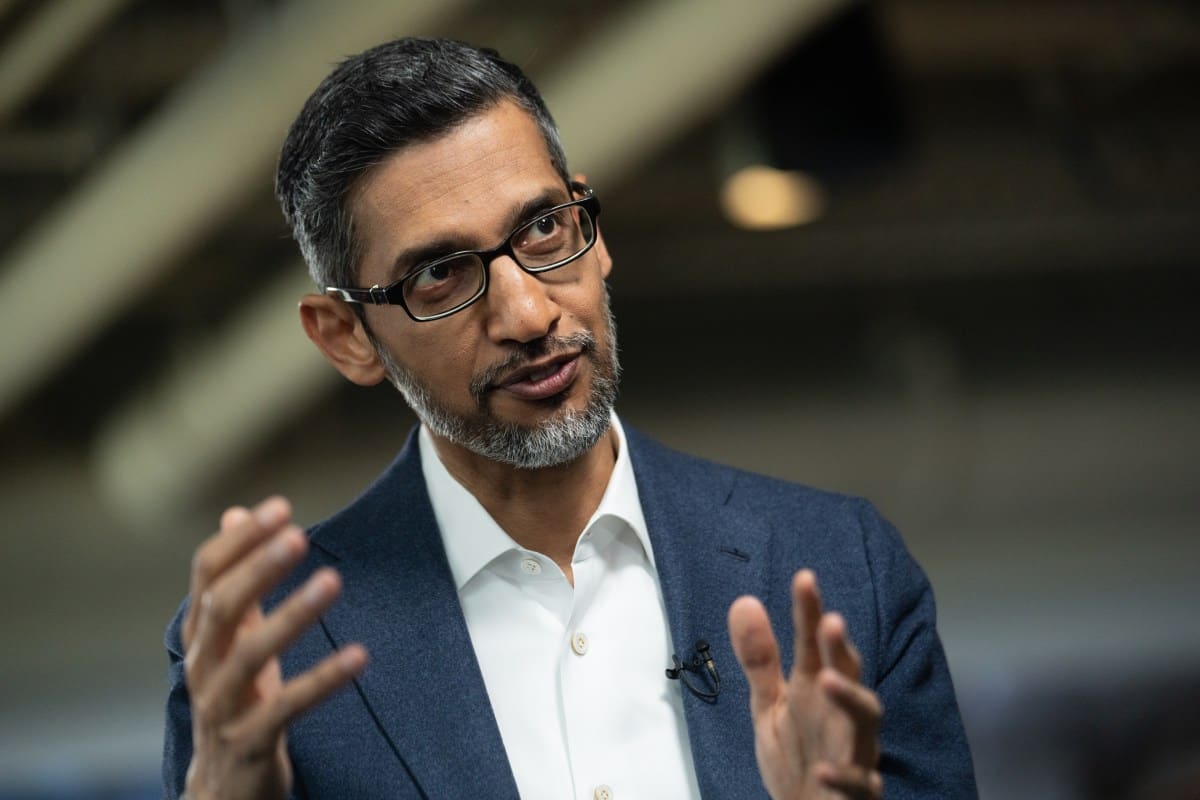
Alphabet's capital expenditure guidance for the year sits between $180 billion and $190 billion, directed primarily toward data center construction, chip procurement, and network infrastructure. During the earnings call, CEO Sundar Pichai faced repeated questions from analysts about the sustainability and expected return profile of this spending level.
Pichai pointed to compute capacity investments planned for 2027 and emphasized long-term contract commitments as indicators of demand durability. His framing suggests the company views current spending not as speculative but as capacity fulfillment for already-secured revenue. The calculus hinges on whether enterprise AI workloads continue to scale or plateau as models become more efficient and require less compute per task.
The tension between rising capital intensity and investor expectations is not unique to Alphabet. Across the hyperscale cloud providers, capital expenditure as a percentage of revenue has climbed steadily since late 2024, driven by the need to maintain competitive inference speeds and training capacity. The difference lies in conversion rates: how effectively each provider translates infrastructure into contracted revenue. Alphabet's backlog figure suggests it is converting at a higher rate than many anticipated.
Regional Dynamics and Competitive Pressure
While Alphabet's results are global, the enterprise AI adoption curve varies significantly by region. In Southeast Asia and India, where DailyTechWire maintains close contact with infrastructure buyers, the primary driver is cost arbitrage: running inference workloads in-region rather than routing through US or European data centers. Alphabet has expanded its cloud footprint in Singapore, Mumbai, and Jakarta over the past year, positioning itself to capture latency-sensitive workloads that competitors with lighter regional infrastructure cannot serve as effectively.
In China, where Alphabet has limited direct presence, domestic cloud providers dominate AI infrastructure spending. However, multinational enterprises operating in both China and other markets often select a single global provider for non-China operations, creating a winner-take-most dynamic in the rest of Asia. Alphabet's contract backlog likely reflects several of these multi-region deals, which tend to be structured as three-to-five-year commitments with minimum spend thresholds.
The competitive landscape remains fluid. While Alphabet's growth rate is impressive, it comes off a smaller base than the market leader in cloud infrastructure. The question is whether the company can sustain this growth velocity as it scales, or whether it will converge toward the broader market growth rate as its revenue base expands.
The 2027 Inflection Point
Pichai's reference to 2027 compute capacity investments suggests the company is planning for another wave of infrastructure expansion, even as current capacity comes online. This forward commitment reflects confidence in sustained demand, but it also locks the company into a capital cycle that will be difficult to reverse if enterprise AI spending slows.
The risk is not that AI workloads disappear, but that efficiency gains in model architectures reduce the compute required per task, compressing revenue growth even as usage increases. Recent advances in model distillation and quantization have already reduced inference costs by an order of magnitude for certain workloads. If that trend accelerates, the revenue-per-compute ratio could decline, pressuring margins and return on invested capital.
For now, Alphabet's results indicate that enterprise customers are prioritizing capability and performance over cost optimization, a dynamic that favors infrastructure providers willing to spend heavily on the latest hardware. Whether that preference persists through 2027 will determine whether the company's capital expenditure strategy is vindicated or requires recalibration.
The contract backlog provides a buffer, but it is not a guarantee. Enterprise agreements often include performance clauses and renegotiation windows, particularly for multi-year commitments in a technology category as rapidly evolving as AI. The true test will come not in the next quarter, but in whether those contracts renew and expand when they reach their initial terms.
Alphabet's cloud surge offers the clearest evidence yet that enterprise AI spending is translating into infrastructure revenue at scale. The magnitude of the growth, combined with the contract backlog, suggests the company has successfully positioned itself as a default provider for a category of workload that did not exist at commercial scale three years ago. The durability of that position will depend on execution, efficiency gains, and whether the AI workload growth curve sustains its current trajectory through the decade.