Alibaba Cloud Hits Fastest Growth in Five Years as AI Revenue Triples
The Chinese tech giant's cloud and AI division posted 45% revenue growth in Q2 2024, but massive infrastructure spending signals a long-term bet on model training and inference workloads across Asia.
A Return to Double-Digit Momentum
Alibaba Group's cloud and artificial intelligence division delivered its strongest quarterly performance in more than five years, recording 45 percent year-on-year revenue growth in the three months ending June 30. The segment, which the company now calls AI Cloud and Compute Services, generated 48.4 billion yuan in revenue during the period, according to Alibaba.
The acceleration marks a notable inflection point. For nearly two years, Alibaba's cloud business had been mired in single-digit or low-teens growth as competition from Huawei Cloud, Tencent Cloud, and ByteDance intensified and as Beijing's regulatory crackdown dampened enterprise IT spending. The June quarter represents the fastest expansion the division has seen in 22 quarters, a tempo last observed in early 2021 when pandemic-era digitalization was still driving corporate cloud adoption across China.
At DailyTechWire, we've tracked the gradual repositioning of China's hyperscalers from generic infrastructure-as-a-service providers into AI-first platforms. Alibaba's latest results suggest that repositioning is beginning to pay off, at least in top-line terms. The question now is whether margin expansion can keep pace with the capital intensity required to serve large-language-model training and inference workloads.
AI Services Drive the Surge
The growth was overwhelmingly concentrated in AI-related revenue, which more than tripled year-on-year within the cloud division. Alibaba attributes the surge to accelerating enterprise adoption of its Qwen large language model family, now in its third generation, and to rising demand for model fine-tuning and inference APIs sold through its Alibaba Cloud Model Studio platform.
Model Studio, launched in beta in late 2023, offers developers access to dozens of open-weight and proprietary models, including Qwen, Baichuan, and several domain-specific fine-tunes for finance, healthcare, and e-commerce. Pricing is consumption-based, with inference charged per token and fine-tuning billed by GPU-hour. The platform has become a key revenue driver as Chinese enterprises, barred from using OpenAI's commercial API and wary of data sovereignty concerns with Western providers, seek domestically hosted alternatives.
Alibaba also disclosed that its T-Head semiconductor unit, which designs RISC-V cores and AI accelerators, is now folded into the same reporting segment. T-Head's Yitian server chips and Xuantie processors are being deployed internally to reduce reliance on Nvidia GPUs, which remain subject to U.S. export controls. The company has not broken out T-Head's standalone contribution, but industry observers believe chip sales to third parties remain marginal; the unit's primary role is to lower Alibaba's own infrastructure cost per inference call.
Profitability Under Pressure from Capex
Despite the revenue acceleration, the cloud division's operating margin remains under scrutiny. Alibaba reported group-wide adjusted profit of 27.3 billion yuan for the quarter, ahead of analyst consensus, but the company also signaled that capital expenditure would remain elevated throughout the fiscal year.
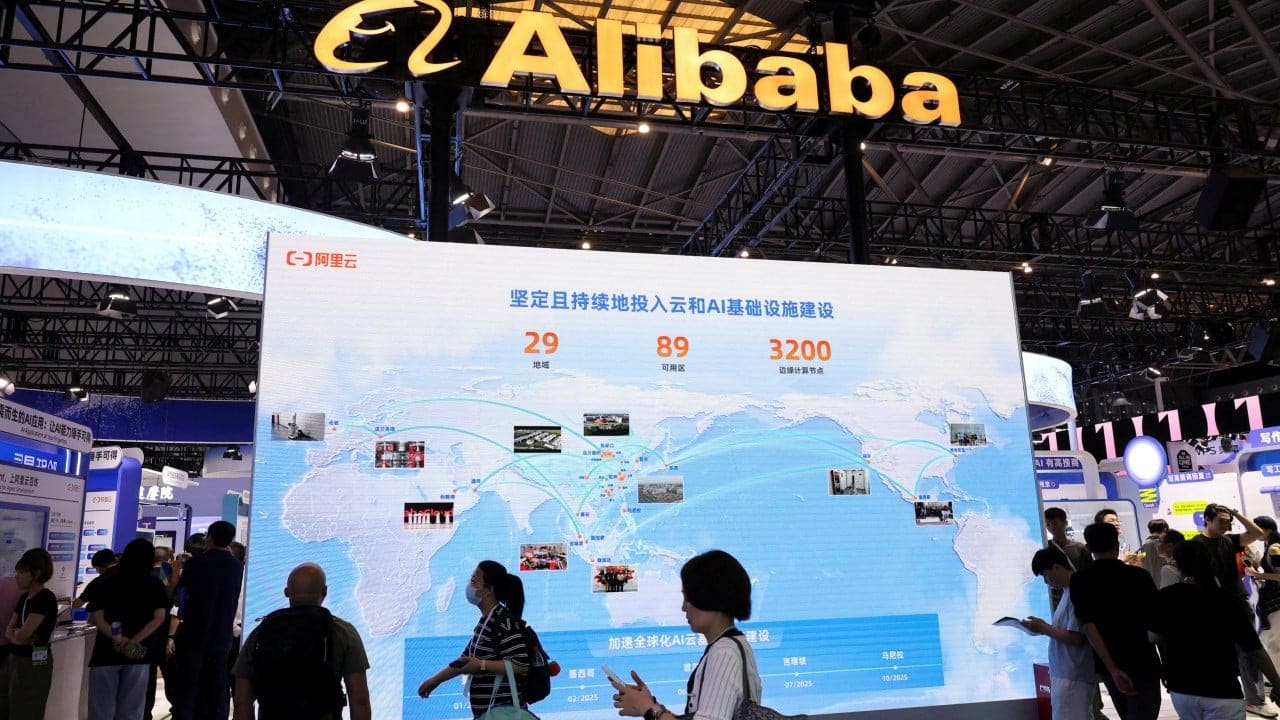
Management commentary during the earnings call emphasized ongoing investment in data center expansion, GPU clusters, and liquid-cooling infrastructure to support training runs for Qwen models exceeding 100 billion parameters. Alibaba operates more than 80 data centers across China, Southeast Asia, and the Middle East, and it is racing to add capacity in Singapore, Jakarta, and Riyadh to capture regional AI workloads.
The capital intensity is not unique to Alibaba. Across the region, Tencent, ByteDance, and Baidu are all pouring billions into AI infrastructure, creating a capacity arms race that echoes the hyperscale buildout in North America but with tighter margin constraints due to lower average revenue per customer in emerging markets. At DailyTechWire, we've noted that this dynamic is likely to separate winners and losers over the next 18 months: companies that can achieve high GPU utilization and low idle time will see unit economics improve, while those that overbuild will face margin compression.
Regional Expansion and the Southeast Asia Play
Alibaba's cloud growth is not confined to mainland China. The company has been steadily expanding its footprint in Southeast Asia, where it competes with AWS, Google Cloud, and regional players like Telkom Indonesia and Singapore Telecommunications. Alibaba Cloud currently holds the third-largest market share in the ASEAN region, behind AWS and Azure, but its AI model offerings are gaining traction among local enterprises that prefer Mandarin- and Bahasa-capable models over English-first alternatives.
The company has also struck partnerships with several ASEAN governments to provide cloud infrastructure for smart-city initiatives, digital identity systems, and e-government platforms. These deals, often structured as build-operate-transfer arrangements, provide long-term recurring revenue but require significant upfront capital and carry execution risk.
Indonesia represents a particularly strategic market. Alibaba Cloud operates two availability zones in Jakarta and has committed to a third, with plans to integrate Qwen-based chatbots into government portals and state-owned enterprise workflows. The Indonesian government's push for data localization and its preference for non-Western technology vendors create an opening, but profitability in the market remains elusive due to price sensitivity and the need for local co-investment.
The Qwen Ecosystem and Open-Weight Strategy
Alibaba's decision to release the Qwen model family under a permissive open-weight license has been central to its cloud strategy. Qwen 2.5, the latest iteration, offers models ranging from 0.5 billion to 72 billion parameters, with multilingual support for Mandarin, English, Japanese, Korean, and several Southeast Asian languages.
By open-sourcing the weights, Alibaba has seeded a developer ecosystem that drives demand for its inference and fine-tuning services. Thousands of startups and enterprises across Asia have built applications on top of Qwen, and many of those workloads run on Alibaba Cloud infrastructure due to latency, compliance, and integration advantages. The approach mirrors Meta's Llama strategy but is executed in a market where data sovereignty concerns are more acute and where Western cloud providers face regulatory and political headwinds.
Alibaba has also begun offering sovereign AI cloud packages, which bundle Qwen models, T-Head inference accelerators, and on-premises deployment options for governments and regulated industries. These packages are designed to compete with Huawei's Pangu models and Baidu's Ernie platform, both of which have strong footholds in the public sector.
Risks and the Road Ahead
The cloud division's rapid growth comes with structural risks. U.S. export controls on advanced semiconductors continue to constrain Alibaba's ability to procure cutting-edge GPUs, forcing the company to rely on older architectures and domestically designed accelerators that lag Nvidia's H100 and upcoming Blackwell chips in performance per watt. This gap could widen if Washington tightens restrictions further or if TSMC, which fabricates T-Head's chips, faces pressure to limit shipments.
Competition is also intensifying. ByteDance, flush with TikTok revenue, is aggressively subsidizing its Volcano Engine cloud platform and has been winning workloads from media, gaming, and consumer internet customers. Huawei, meanwhile, benefits from state backing and preferential treatment in government and telecom sector deals. Alibaba's historical strength in e-commerce and logistics gives it an edge in retail and supply-chain AI applications, but those verticals represent a narrower addressable market than the horizontal platform plays pursued by AWS and Azure.
Longer term, the sustainability of AI-driven cloud growth depends on whether enterprises move beyond experimentation and deploy models in production at scale. Many of the workloads currently driving Alibaba's AI revenue are pilot projects, proof-of-concepts, and developer sandboxes. The transition to production inference, where cost per query and latency become critical, will test whether Alibaba's infrastructure and pricing can compete with established players.
For now, the June quarter results demonstrate that Alibaba has regained momentum in a segment that accounts for roughly 12 percent of group revenue but carries strategic importance far beyond its current contribution. The company's ability to translate AI-driven top-line growth into sustainable margin expansion will define its competitive position in the region's cloud market over the next several years.