How AI Training Economics Are Reshaping Memory Chip Markets
SK Hynix's $26.5 billion U.S. listing underscores the strategic shift in semiconductor supply chains as high-bandwidth memory becomes infrastructure.
The Capital Event That Signals a Structural Shift
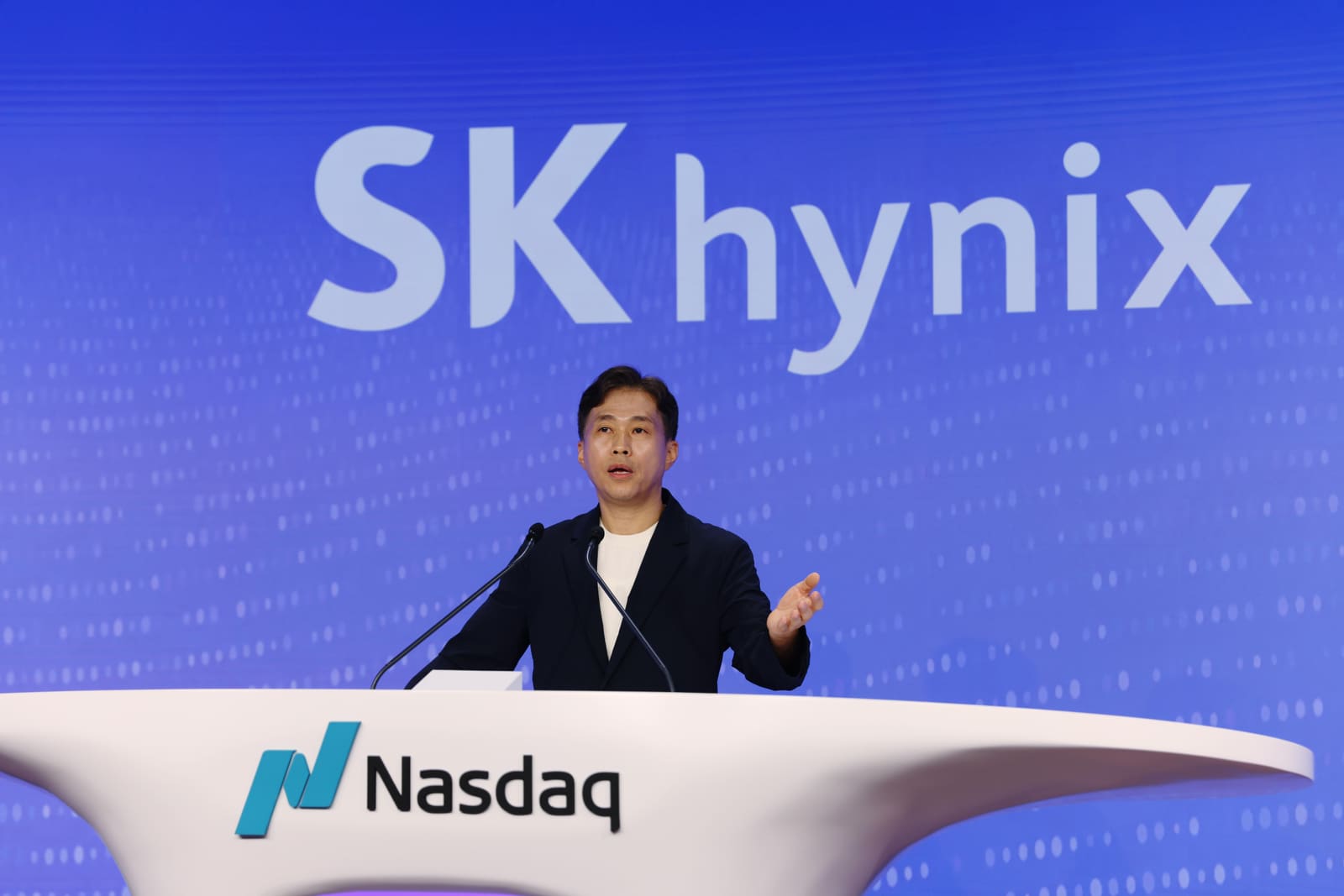
A South Korean memory chipmaker pulled off the largest foreign company listing in U.S. history last Friday, raising $26.5 billion and opening at $170 per share. The debut of SK Hynix on Wall Street is more than a financing milestone. It reflects a fundamental reconfiguration in semiconductor supply chains, driven by the computational demands of large language models and the infrastructure race across hyperscalers.
At DailyTechWire, we've tracked the rising strategic importance of high-bandwidth memory in AI training clusters over the past eighteen months. What began as a niche specification for accelerator interconnects has evolved into a bottleneck that determines who can scale inference and fine-tuning workloads economically. SK Hynix, alongside Samsung and Micron, sits at the center of that bottleneck, and its valuation trajectory tells the story of a component category becoming infrastructure.
Why Memory Suddenly Commands a Premium
The surge in DRAM and HBM demand stems from architecture choices made by GPU designers and cloud providers. Modern AI accelerators require memory subsystems that can feed parameters to compute cores fast enough to prevent idle cycles. Bandwidth, not just capacity, has become the constraint. HBM stacks multiple DRAM dies vertically and connects them with through-silicon vias, delivering bandwidth measured in terabytes per second rather than the gigabytes typical of conventional modules.
That architectural necessity translates into pricing power. Memory suppliers that can manufacture HBM at volume, with acceptable yield rates and thermal performance, enjoy margins that outpace commodity DRAM by multiples. SK Hynix has invested heavily in HBM production lines, and its customer roster includes Nvidia, the dominant supplier of AI training hardware. The symbiosis is straightforward: as Nvidia ships more H100 and H200 systems, demand for SK Hynix's memory modules scales in lockstep.
The company briefly overtook Samsung as South Korea's most valuable enterprise in May, when its market capitalization crossed the trillion-dollar threshold. That moment was fleeting, but it underscored a broader reordering. Samsung, historically the leader in memory fabrication, has faced yield challenges with its latest HBM generations, ceding ground to SK Hynix in the race to supply hyperscale customers. In an industry where a few quarters of execution advantage can determine years of revenue, that gap matters.
The Regional Context: Seoul's Semiconductor Ambitions
South Korea's government has made semiconductor self-sufficiency a national priority, pouring subsidies into fabrication capacity and research clusters around Seoul and Gyeonggi Province. The country accounts for roughly 60 percent of global DRAM output and a similar share of NAND flash. SK Hynix's Wall Street listing injects capital that will likely flow into next-generation HBM facilities and advanced packaging lines, both critical for maintaining parity with Micron in the U.S. and countering any future export restrictions.
The geopolitical dimension is inescapable. Memory chips fall under the same export control regimes that govern advanced logic nodes, and Washington has signaled willingness to restrict sales of high-performance components to certain jurisdictions. By listing in New York, SK Hynix deepens its integration with U.S. capital markets and, by extension, with the regulatory frameworks that govern technology transfer. It's a hedge, embedding the company more firmly in the ecosystem it supplies.
For investors, the move offers exposure to AI infrastructure without the volatility of early-stage model developers or the concentration risk of a single GPU vendor. Memory demand is diversified across training, inference, edge deployment, and consumer devices. Even if the current wave of generative AI investment moderates, the secular trend toward higher memory bandwidth in compute systems is unlikely to reverse.
Risks Beneath the Rally
The narrative around HBM is compelling, but structural risks remain. Memory markets are notoriously cyclical. Oversupply can collapse prices within quarters, erasing margins and stranding capacity investments. The current upcycle is sustained by AI capex from a handful of hyperscalers and cloud providers. If model training costs plateau or inference shifts to lower-bandwidth architectures, demand could soften faster than supply adjusts.
Yield and thermal management also pose execution risks. HBM production is technically demanding, with defect rates that can swing profitability. Competitors are not standing still: Micron has ramped its own HBM output, and Samsung is working through its yield issues. A return to equilibrium in the supplier landscape could erode the pricing premium SK Hynix currently commands.
Then there's the question of vertical integration. Nvidia and other accelerator vendors have explored designing custom memory controllers and even co-packaging memory with compute dies. If that trend accelerates, it could reduce the bargaining power of standalone memory suppliers, shifting value capture upstream to system architects.
What This Means for Asia's Tech Ecosystem
The SK Hynix debut is a data point in a larger pattern: Asia's technology supply chains are accessing Western capital markets to fund the next phase of infrastructure buildout. We've seen similar moves from semiconductor equipment makers and fabless design houses across Taiwan, Singapore, and South Korea. The capital is flowing toward the picks-and-shovels layer, the companies that enable AI deployment rather than those building models.
For founders and venture investors in the region, the lesson is clear. Component shortages and supplier concentration create openings. Startups working on memory interconnects, thermal solutions for HBM stacks, or software that optimizes memory bandwidth utilization can position themselves as enablers in a market where supply-side innovation is as valuable as algorithmic breakthroughs.
The trillion-dollar valuation SK Hynix touched in May may prove transient, subject to the same cyclicality that has always governed memory markets. But the company's ability to command that valuation, even briefly, signals a recognition that memory is no longer a commodity input. It's a strategic layer in the stack, and the firms that control it wield influence that extends well beyond their balance sheets.